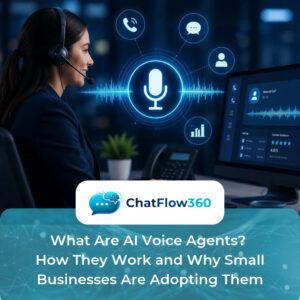
What Happens When Your Business Can’t Answer the Phone?
Imagine a potential customer calling your business after normal working hours. They want to ask about your services, check whether you can help with a problem, or find out how to book an appointment.
But your office is closed, your team is unavailable, and nobody answers the phone.
The caller might leave a voicemail. They might try again tomorrow. Or they might contact a competitor who responds sooner.
For small and medium-sized businesses, this creates an important question: how can you make it easier for customers to reach your business when your team is busy or unavailable?
An AI receptionist offers one possible solution.
AI receptionists use conversational artificial intelligence to interact with callers through spoken conversations. Depending on the system and its configuration, they can answer common questions, collect information, qualify leads, and guide callers toward an appropriate next step.
Some solutions can also support calls outside normal business hours, provided the service is configured and available for that purpose.
In this guide, we’ll explore how AI receptionists work, how they can support lead generation, and what businesses should evaluate before choosing an AI voice solution.
What Is an AI Receptionist?
An AI receptionist is a software-based assistant designed to handle selected receptionist tasks using artificial intelligence and voice technology.
Unlike a traditional automated phone menu that asks callers to press numbers, a conversational AI receptionist is designed to understand spoken requests and respond in natural language.
Depending on its capabilities, an AI receptionist may help businesses:
- Answer incoming calls.
- Respond to frequently asked questions.
- Collect caller names and contact information.
- Ask questions to understand a potential customer’s needs.
- Provide general information about services and business policies.
- Route calls or direct callers to the appropriate next step, where supported.
Not every AI receptionist offers all these functions. Available features depend on the provider, configuration, integrations, and subscription.
The purpose is not necessarily to replace a human receptionist. Instead, AI can help automate suitable interactions while allowing employees to focus on conversations that require personal attention and judgment.
How Do AI Receptionists Answer Business Calls?
Understanding how an AI receptionist works can help you determine whether it fits your business needs.
1. A customer calls your business
The process begins when a customer places a call through a supported phone setup.
For example, someone might call a home services company and ask, “Do you offer emergency plumbing repairs?”
The way the call reaches the AI receptionist depends on the phone system and how the business configures its incoming calls.
2. The AI interprets the caller’s question
Speech recognition technology processes the caller’s words, while conversational AI helps interpret the request.
The system then uses its available business information and instructions to determine an appropriate response.
The quality of the interaction depends on factors such as audio clarity, language support, the information provided to the system, and the complexity of the question.
3. The AI provides a relevant response
If the question falls within the system’s supported capabilities, the AI receptionist can respond using the information available to it.
For example, it may explain a service, provide business hours, or ask a follow-up question to clarify what the caller needs.
Businesses should ensure that the system uses accurate information and has a defined process for questions it cannot answer confidently.
4. The conversation moves toward an appropriate next step
Depending on the platform, the receptionist may collect contact information, gather details about the inquiry, or direct the caller toward another resource.
Some solutions also support call transfers, appointment scheduling, or integrations with business software. These capabilities must be confirmed for the specific product before a business relies on them.
The goal is to make the interaction useful, rather than simply answering the phone without helping the caller move forward.
Can an AI Receptionist Really Answer Calls 24/7?
Some AI receptionist services can be configured to operate outside regular business hours, including overnight, on weekends, and during holidays.
However, 24/7 call answering is not an automatic feature of every AI receptionist.
Availability depends on the provider, subscription, phone configuration, service limits, and whether the relevant functionality is enabled.
Before choosing a solution, ask these questions:
- Can the service receive calls outside normal business hours?
- Does the phone system need to be configured to route calls to the AI?
- Are there usage limits or additional charges?
- What happens if the service is unavailable?
- Can callers reach a human when necessary?
- What process handles urgent or sensitive inquiries?
A business should also decide what after-hours callers need to know. Some may only need general information, while others may expect a callback or help with an urgent request.
Setting clear expectations is essential to providing a useful customer experience.
How AI Receptionists Help Businesses Capture More Leads
Answering a call is only the first step. To create business value, the interaction should help a potential customer move closer to the next stage of their journey.
1. Capture inquiries that might otherwise go unanswered
When employees are busy or the business is closed, callers may struggle to reach someone.
An appropriately configured AI receptionist may help manage supported calls during these periods and give callers a way to share what they need.
This can create more opportunities to follow up, although it does not guarantee that every inquiry will become a customer.
2. Qualify potential customers
Not every inquiry is equally relevant to your business.
Depending on the system, an AI receptionist may ask questions about the caller’s needs, location, preferred service, or other relevant details.
For example, a cleaning company might want to know whether the caller needs residential or commercial cleaning.
The resulting information can help the team understand the inquiry and decide how to respond.
3. Reduce friction in the customer journey
Customers often want straightforward answers before deciding whether to purchase a service.
An AI receptionist may help provide supported information without requiring callers to wait for an employee to become available.
For example, a caller might want to know whether a business serves their area or what information they should prepare before requesting a quote.
A smoother first interaction can help customers understand the next step, provided the information is accurate and relevant.
4. Support appointment-related inquiries
For appointment-based businesses, phone calls may be an important part of the booking process.
Some AI receptionist platforms can support appointment requests or booking workflows when the necessary capabilities and integrations are available.
However, businesses should distinguish between collecting an appointment request and actually checking live availability, creating a booking, and sending a confirmation. These are different functions and should be verified individually.
5. Help employees prioritize follow-up
When a system can capture relevant inquiry details, employees may have a clearer picture of why someone called.
Instead of starting every follow-up conversation from scratch, the team may be able to use the information collected during the initial interaction.
The practical benefit depends on what information the system captures, how it is delivered to employees, and whether it integrates with existing business processes.
Which Businesses Can Benefit From AI Receptionists?
AI receptionists may be useful across industries where customers frequently call to ask questions, request services, or explore purchasing options.
Home services and contractors
Plumbers, electricians, landscapers, and cleaning companies often receive calls while employees are working at customer locations.
An AI receptionist may help collect details about service requests and provide supported information while the team is occupied.
Healthcare and wellness
Clinics, dental offices, and wellness businesses may explore AI voice solutions for general administrative inquiries.
Privacy, applicable regulations, and escalation procedures are particularly important in these settings. Sensitive medical information and urgent health concerns require appropriate safeguards and human oversight.
Real estate
Real estate agents may receive inquiries about properties, viewing requests, and service areas.
Depending on the solution, an AI receptionist may help collect prospective buyers’ or renters’ requirements and direct them toward an appropriate next step.
Professional services
Law firms, consultants, and accounting practices may use AI voice technology to support initial inquiries and gather basic information.
Complex legal, financial, or other sensitive questions should be handled by appropriately qualified professionals.
Retail and local businesses
Retailers and other local businesses may receive recurring questions about opening hours, products, locations, and policies.
An AI receptionist configured with accurate information may help answer supported questions and reduce unnecessary interruptions to employees.
Across all industries, the best use cases begin with identifying repetitive interactions that can be handled reliably without compromising customer experience.
AI Receptionist vs. Traditional Answering Services
How does an AI receptionist compare with voicemail or a traditional answering service?
| Capability | Voicemail | Human answering service | AI receptionist |
|---|---|---|---|
| Immediate interaction | Records a message | Depends on service coverage | Can respond during supported, available calls |
| Answers common questions | No, not by itself | Depends on the agent and provided information | Depends on system knowledge and configuration |
| Collects caller details | Through the recorded message | Usually possible | Possible when supported |
| Handles conversational questions | No | Yes, within the agent’s knowledge | Within the AI system’s capabilities |
| Appointment workflows | Not independently | Depends on the service | Depends on platform capabilities and integrations |
| Human judgment | Requires follow-up | Provided by the agent | May require escalation |
There is no single best option for every business.
Voicemail may be sufficient for businesses with low call volume. A human answering service may be preferable when callers frequently need empathy, judgment, or complex assistance. An AI receptionist may suit businesses seeking to automate selected routine interactions.
The right choice depends on your customers, workflows, budget, and service expectations.
What to Look for in an AI Receptionist
Before adopting an AI receptionist, evaluate the following:
- Call availability: Confirm when the system can answer calls and whether after-hours coverage is supported.
- Accurate business information: Check whether you can configure and maintain the information the AI uses.
- Lead qualification: Determine whether it can ask the questions your business needs.
- Call routing: Verify whether transfers or routing workflows are available.
- Appointment support: Confirm whether the system can request appointments or complete bookings.
- Language support: Check that it supports the languages your customers use.
- Privacy and security: Understand how call recordings and customer information are handled.
- Pricing and limits: Review subscription costs, usage restrictions, and any additional fees.
- Monitoring and improvement: Establish a process for testing conversations and reviewing unresolved inquiries.
Start with a small set of common call scenarios. Test what happens when callers ask unexpected questions, provide incomplete information, or request assistance that the system cannot provide.
This will help you identify where automation is appropriate and where human involvement remains essential.
Exploring ChatFlow360 AI Voice
ChatFlow360 AI Voice is an option for businesses interested in exploring AI-powered phone conversations.
ChatFlow360’s website describes voice capabilities intended to support business phone interactions, including incoming calls, lead qualification, and appointment-related workflows. The exact availability and operation of individual features should be confirmed with the ChatFlow360 team.
If you are considering an AI receptionist, start by identifying the calls you want to handle more effectively.
Do customers frequently ask the same questions? Does your team struggle to answer calls while serving other customers? Do you need a better way to collect information from potential clients?
These questions can help you determine whether an AI voice solution is worth evaluating.
A ChatFlow360 AI Voice demo can help you discuss your use cases, understand the product’s current capabilities, and establish whether it fits your business requirements.
Frequently Asked Questions
Can an AI receptionist answer calls 24 hours a day?
Some services can be configured for continuous call handling, but availability depends on the provider, phone setup, service terms, and configuration. Confirm these details before relying on 24/7 coverage.
Can an AI receptionist generate leads?
An AI receptionist may help capture inquiries and qualify prospective customers by collecting relevant information. Lead generation results depend on call volume, customer intent, the quality of the interaction, and the business’s follow-up process.
Can an AI receptionist transfer calls to a human?
Some systems support call transfers or other escalation workflows. Confirm whether the selected platform supports the required routing process and how it behaves when employees are unavailable.
Can an AI receptionist book appointments?
Some solutions support appointment-related workflows. Businesses should verify whether the system can collect requests, check calendar availability, create bookings, and send confirmations, rather than assuming all these functions are included.
Is an AI receptionist suitable for small businesses?
It may be a good fit for businesses that receive recurring phone inquiries, experience busy periods, or want to improve how they manage calls outside normal operating hours. Suitability depends on the use case, costs, and available features.
How do I get started with ChatFlow360 AI Voice?
Visit the ChatFlow360 website and request a demo or further information to discuss your business needs and verify the current availability of the features you want to use.
Conclusion: Make Every Customer Interaction Count
AI receptionists offer businesses another way to manage phone communication, answer routine questions, and capture information from prospective customers.
For small and medium-sized businesses, the potential benefit is not simply answering more calls. It is creating a clearer path for customers to get information, express their needs, and move toward the next step.
Before adopting a solution, define your goals, confirm the available capabilities, and test realistic conversations. Pay particular attention to after-hours availability, lead qualification, privacy, and the situations that require human assistance.
Ready to explore AI-powered phone conversations for your business?
Request a ChatFlow360 AI Voice Demo
Discover how ChatFlow360 AI Voice could fit into your customer communication strategy. Request a demo to discuss your use cases, explore available capabilities, and determine whether the solution meets your business needs.